The GenAI Balancing Act: Engineering Velocity vs. Enterprise Security
Published Date:
The conversation around AI coding assistants has fundamentally shifted. A year ago, we were testing whether these tools actually worked. Today, the question is how we manage them at scale.
Data from recent industry studies highlights that enterprise adoption of AI coding assistants has surged by over 300% in the last year. Engineering teams are seeing tangible gains—sometimes upwards of a 25% increase in task completion rates, particularly during the onboarding of newer developers. The velocity is real, and the developer experience is demonstrably improving.
However, as technology leaders, we have to look at the entire board. When we bring tools like GitHub Copilot, Claude Code, or Codex into our development environments, we aren’t just adding a new autocomplete feature. We are introducing systems that interact directly with our proprietary source code, internal architecture, and developer credentials.
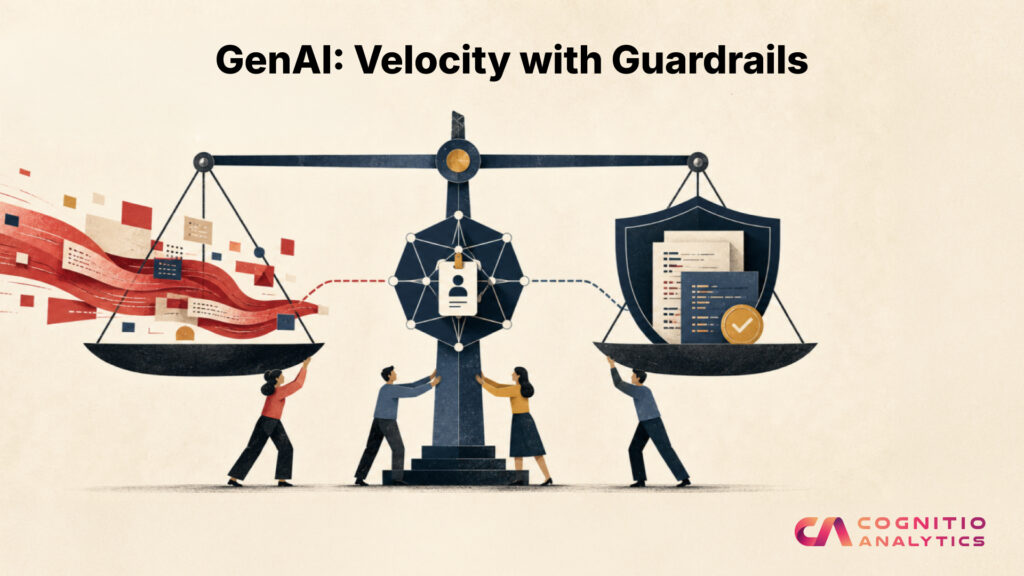
This creates a distinct tension between engineering velocity and enterprise security.
How do we empower our teams to move faster while maintaining robust information security and protecting our intellectual property?
As I’ve navigated these discussions with engineering, security, and legal teams, a few core principles have stood out:
1. Treat AI as a Privileged Identity, Not Just a Tool
The primary risk isn’t necessarily the popularity of these tools, but their reach. Coding assistants sit extremely close to source control and build artifacts. We have to start treating them as governed, non-human identities with endpoint reach. This means defining clear boundaries around what they can access, what telemetry they send back, and how they handle our IP.
2. Shift the Focus from Writing to Reviewing
AI is excellent at absorbing boilerplate tasks and generating code structures. But this fundamentally changes the developer’s day-to-day work. The bottleneck is shifting from writing code to reviewing it. Reading and validating AI-generated code can be cognitively taxing, and if we aren’t careful, we risk generating technical debt at an unprecedented pace. We need to adapt our engineering culture so that rigorous architectural design and security validation take precedence over sheer volume of output.
3. Move Beyond the “Approved List”
It is no longer enough for an IT department to simply approve or block an application. The reality is that developers are often using multiple AI tools simultaneously to solve different problems. A rigid, top-down mandate usually leads to shadow IT. Instead, we need to build AI-aware security scanning and governance directly into our CI/CD pipelines. If a tool surfaces private code or introduces a vulnerability, the system needs to catch it before it reaches production.
4. Build a Cross-Functional Alliance
The successful adoption of AI cannot be driven by the engineering department alone. It requires an active, ongoing partnership between engineering, security, legal, and product teams. When we evaluate the terms of service, data privacy controls, and IP indemnification of these platforms, everyone needs a seat at the table. We have to design operating models where security teams support rather than block innovation.
The goal isn’t to build a fortress that keeps AI out. The goal is to build a resilient, secure framework that allows our engineering teams to use the best tools available with confidence.
Amit Saini
CTO
Amit has over 20 years of professional experience with more than 15 years on Product Development and management. Rich experience of building enterprise products from grounds up – Data Management and Analytics Platform, Sales Operations Cloud, Business Rules Engine, B2B Integration products – cloud and on premise, Business Process Manager and Server Side Security management software.
Explore the Latest
Discover trends and strategies shaping smarter, faster business processes.