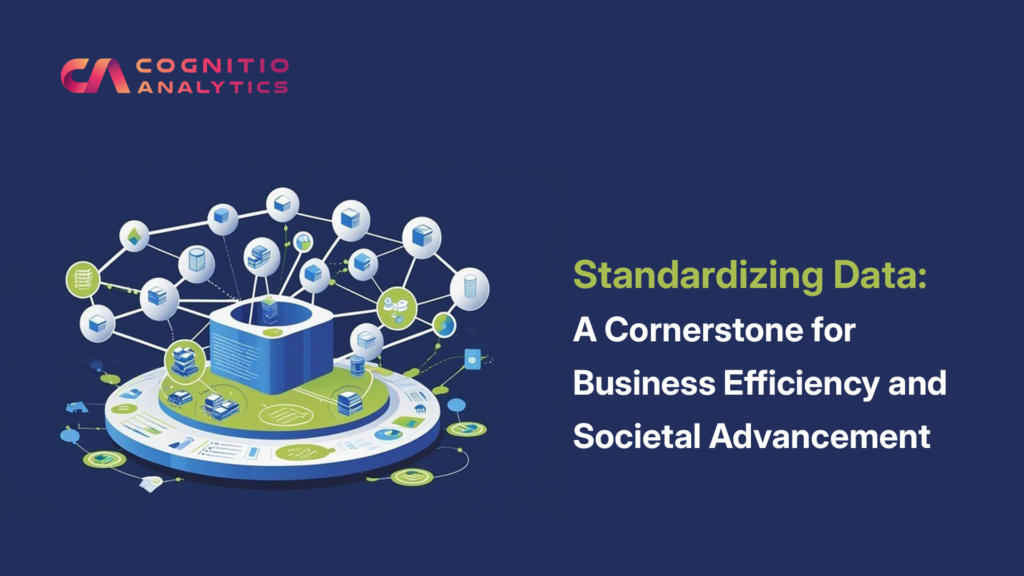
Standardizing Data: A Cornerstone for Business Efficiency and Societal Advancement
- Published Date:
Executive Summary
In a global economy driven by digital transformation, data has become a fundamental asset. Yet as the volume and variety of data continue to grow, most organizations struggle with a persistent obstacle: the lack of data standardization. Siloed systems, incompatible data models, and inconsistent terminologies hinder integration, analytics, and innovation. Standardized, domain-specific data models—developed collaboratively and adopted at scale—offer a way forward. This paper explores the need for data standardization, examines real-world implementations, outlines how open standards can be developed, and calls for active participation from industry leaders, governments, and international bodies.
1. The Problem: Data Fragmentation in a Hyperconnected World
Organizations today often build data models independently, focused on internal optimization. While this approach may serve near-term needs, it leads to a proliferation of proprietary formats that complicate collaboration, delay product development, and drive up operational costs. The ripple effects are felt in nearly every industry:
- Data silos create duplication and prevent 360-degree views of customers, operations, or outcomes.
- Integration costs rise due to custom mapping and transformation layers.
- Analytics quality suffers from inconsistent definitions, missing data, and incompatibility.
These challenges limit not only operational efficiency but also the broader capacity for industries to collaborate, innovate, and respond to global challenges.
2. Sector Spotlight: Examples of Standardization in Action
Healthcare: HL7 FHIR and OpenEHR
- HL7 FHIR (Fast Healthcare Interoperability Resources) allows systems to exchange specific healthcare data components—such as lab results, medications, and imaging—using a common format. Hospitals adopting FHIR can integrate with electronic health records (EHRs), insurance claims processors, and research systems far more easily than before.
- OpenEHR takes a slightly different approach, offering a vendor-neutral architecture for electronic health data. The UK’s NHS and several Scandinavian countries use OpenEHR to ensure long-term interoperability and patient data continuity.
Finance: FIBO and ISO 20022
- FIBO (Financial Industry Business Ontology) provides a formal data model that unifies financial terms and relationships. Investment firms use FIBO to standardize portfolio reporting and risk analysis across subsidiaries.
- ISO 20022 is a global standard for electronic data interchange between financial institutions. Adopted by SWIFT and central banks in over 70 countries, ISO 20022 simplifies cross-border payments, enhances anti-money laundering controls, and improves financial transparency.
GS1, the organization behind barcodes, provides standardized identifiers and data formats for products, logistics, and locations. Major retailers like Walmart and Amazon use GS1 to streamline inventory management, traceability, and vendor collaboration. In food supply chains, GS1 standards help trace the origin of goods during contamination events, reducing health risks.
Public Sector: NIEM (National Information Exchange Model)
The NIEM initiative, used by U.S. federal and state agencies, enables secure and consistent data sharing across law enforcement, emergency management, and human services. NIEM has facilitated improved disaster response coordination and inter-agency collaboration during crises such as Hurricane Katrina and COVID-19.
3. Business Case: Why Standardization Matters
The benefits of data standardization go beyond operational efficiency. For businesses, it unlocks long-term strategic advantages:
- Reduced Integration Costs: Less time spent cleaning, mapping, and validating data.
- Faster Time to Insight: More consistent data means better and quicker analytics.
- Increased Interoperability: Easier integration with customers, suppliers, and partners.
- Improved Compliance: Standards aligned with regulations make reporting simpler and less risky.
- Stronger AI and Automation: AI models trained on standardized data perform better and require less preprocessing.
For society, the implications are even greater:
- Improved Healthcare Outcomes: Standardized patient data supports better diagnoses and population health research.
- Environmental Monitoring: Shared data formats for climate data enable collaboration on emissions tracking, biodiversity research, and sustainability initiatives.
- Crisis Response: Common models improve data sharing between government agencies, NGOs, and private firms during disasters.
4. Enabling Standardization Through Open Collaboration
Creating open, domain-specific data standards requires thoughtful governance and inclusive processes. Successful initiatives typically share several key elements:
a. Convening a Diverse Coalition
- Include stakeholders across the value chain: producers, consumers, regulators, technology providers, and standards experts.
- For example, The TUVA Project, an open-source initiative for healthcare analytics, brings together clinicians, data engineers, and policy advisors to co-design data models usable by hospitals, researchers, and insurers.
- Define roles for contributors, maintainers, and reviewers.
- Use version-controlled repositories (e.g., GitHub) with transparent change logs.
- Create advisory boards or working groups for major domains (e.g., finance, supply chain, public health).
- Make initial standards simple and extensible.
- Support mappings to legacy systems and provide transformation tools.
- Publish case studies and implementation guides.
d. Ensuring Long-Term Stewardship
- Identify or create a neutral standards organization to maintain the model.
- Examples include HL7, EDM Council, GS1, or new consortia formed specifically for the task.
5. The Role of Governments and International Bodies
Data standardization is too important to leave entirely to market forces. Public institutions have a critical role to play in creating the incentives, infrastructure, and trust needed for meaningful progress.
a. Regulatory Support and Mandates
Governments can accelerate adoption by embedding standard data models into regulatory requirements. For example:
- The Centers for Medicare & Medicaid Services (CMS) in the U.S. now requires APIs based on HL7 FHIR.
- The European Union’s Digital Finance Strategy promotes the adoption of ISO 20022 for banking interoperability.
Governments can fund open-source implementations, public data platforms, and standards development. International bodies like the World Health Organization (WHO) and United Nations Statistical Division can coordinate cross-border standardization of global health, development, and sustainability metrics.
International treaties and digital trade agreements can include provisions for data standards harmonization—especially for industries like shipping, cross-border payments, or climate policy reporting.
6. Moving Forward: A Call to Action
The time for passive observation is over. To realize the full potential of standardized data, industries must act now—collaboratively, transparently, and with long-term vision.
Recommendations for Industry Leaders
- Join or form domain-specific working groups: Leverage industry associations, standards consortia, or open-source communities.
- Adopt and contribute to open models: Where applicable, align internal systems with emerging standards and offer real-world feedback.
- Allocate resources for integration and transformation: Budget not only for tools but also for the people who will steward the change.
Recommendations for Governments and Multilateral Bodies
- Incentivize alignment with standards through funding, grants, or regulatory simplification.
- Support open-source reference implementations that make adoption easier for smaller players.
- Coordinate across borders to align standards where global integration is essential.
Conclusion
Standardizing data is one of the most high-leverage steps industries can take to unlock innovation, reduce costs, and serve society more effectively. The benefits are evident in real-world platforms like Salesforce and Veeva, international efforts like HL7 FHIR and ISO 20022, and open initiatives like TUVA and NIEM.
But standardization doesn’t happen on its own. It requires commitment, coordination, and investment—especially from those in leadership positions. By engaging in structured collaboration and supporting open, domain-specific models, we can create a more efficient, innovative, and resilient global data ecosystem.
The challenge is clear. The path is proven. The time to act is now.

Amit Saini
CTO
Amit has over 20 years of professional experience with more than 15 years on Product Development and management. Rich experience of building enterprise products from grounds up – Data Management and Analytics Platform, Sales Operations Cloud, Business Rules Engine, B2B Integration products – cloud and on premise, Business Process Manager and Server Side Security management software.
Explore the Latest
Discover trends and strategies shaping smarter, faster business processes.