Beyond the AI Hype: In 2026, AI Must Earn Its Way Into Production
- Published Date:
For the past three years, the dominant question in boardrooms was:
“What is our AI strategy?”
In 2026, CEOs and CFOs are asking a much harder question:
“Is our production AI delivering measurable business outcomes—and what are its unit economics?”
The honeymoon period for experimentation is ending. We are entering an era of operational accountability, where speed to production, measurable productivity and disciplined cost management will separate the companies creating an AI advantage from those merely funding AI activity.
The $2.59 trillion reality check
Gartner forecasts worldwide AI spending will reach $2.59 trillion in 2026—a 47% year-over-year increase.
But spending is not value.
IDC reports that roughly two-thirds of organizations now use AI in live production environments. Yet it projects that nearly half of AI-driven use cases will miss their 2026 ROI targets because of unclear business benefits, weak human–AI collaboration and poor data foundations.
S&P Global offers an even sharper reality check: only 37% of surveyed AI initiatives were considered live and delivering value.
The message for technology leaders is clear:
Deploying AI is no longer the competitive advantage. Embedding it into production workflows—with positive unit economics—is.
Three principles for production AI in 2026
1. Redesign the workflow before deploying the technology
Adding an AI assistant to a fragmented process does not transform the process. It simply makes the fragmentation more conversational.
The real gains appear when we reconsider the division of work:
- What should AI retrieve, generate, evaluate or execute?
- Where must human judgment remain?
- Which approvals can be removed or redesigned?
- How will exceptions and failures be handled?
- What business metric should change?
McKinsey’s 2026 research found that leaders were 5.3 times more likely to report enterprise value when workflows had been redesigned—32% versus just 6% when workflows remained unchanged.
This may be the most important lesson for CTOs: AI transformation is not primarily a model-selection exercise. It is an operating-model redesign.
In the early phase of generative AI, teams often used the largest available model for every task. That may have accelerated experimentation, but it is not a sustainable production architecture.
Inference cost must now become a core engineering metric alongside reliability, security and latency.
That means:
- Routing routine tasks to smaller, lower-cost models
- Reserving frontier reasoning models for genuinely complex work
- Controlling context size and unnecessary tool calls
- Caching repeated requests where appropriate
- Monitoring retries, verification loops and cost variance
- Measuring cost per successfully completed business task—not merely cost per token
Agentic AI makes this especially important. McKinsey reports that long-running agent tasks can consume vastly more tokens than ordinary chat interactions. In the production coding workflows it examined, approximately 60% of cost came from reviewing, repairing and verifying outputs.
As one line from the research puts it:
“Tokens are not value. Tokens are the bill.”
Every AI capability therefore needs two connected measures: the business value it creates and the full cost of producing that value.
A model’s benchmark score means little if it takes six months to integrate safely—or if the resulting system does not change a customer, operational or financial outcome.
The right starting points are bounded, high-friction workflows where impact can be measured quickly: customer-support routing, code review, document processing, forecasting, data transformation or claims handling.
Stanford’s 2026 AI Index reports meaningful productivity gains in structured work: approximately 14–15% in customer support, 26% in software development and 50% in marketing output.
These results will not transfer automatically to every company or workflow. But they demonstrate what becomes possible when the work is clearly defined and the output is measurable.
Before implementation begins, teams should establish the baseline:
- Current time per task
- Cost per transaction
- Throughput and error rates
- Customer or employee experience
- Revenue or capacity created
Otherwise, “hours saved” becomes an attractive metric with no clear connection to enterprise value.
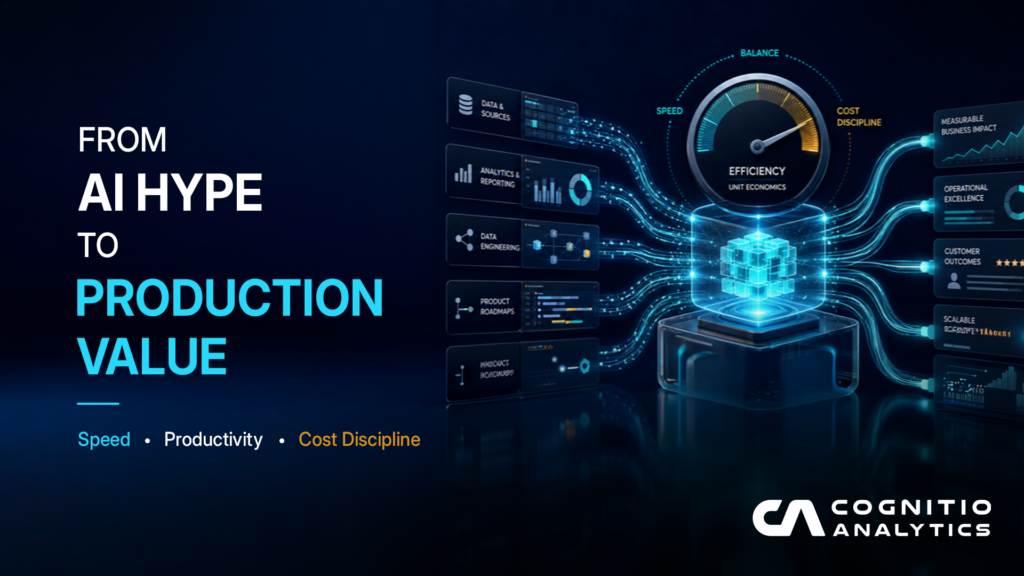
At Cognitio Analytics, this is the strategy we are putting into practice. We are applying GenAI across data analytics, reporting, data engineering, software product management and product engineering—but every implementation is treated as a measurable business capability.
Each use case goes through continuous cycles of cost monitoring, optimization and efficiency improvement. Equally important, we invest in better tooling and in developing the skills and people capabilities required to use AI responsibly at scale. The objective is not adoption for its own sake; it is better decisions, stronger delivery and demonstrable value at a sustainable cost.
The CTO’s production scorecard
For every AI initiative, leadership should be able to answer five questions:
- Which business outcome are we changing?
- What baseline will prove that it improved?
- How must the workflow change for that value to appear?
- What are the acceptable cost, quality and risk thresholds?
- How quickly can we launch a controlled production version and learn from it?
The objective is not to deploy AI everywhere. It is to deploy it quickly where it can make a measurable difference—and then scale what works.
Speed matters. But sustainable speed matters more.
The winners in 2026 will not be the companies with the most AI prototypes. They will be the ones that build the fastest learning loop between a business problem, a production deployment, measured value and disciplined optimization.
That is how AI moves from hype to capability—and from a growing technology bill to a durable competitive advantage.
How is your organization connecting AI productivity with production cost and measurable business value?

Amit Saini
CTO
Amit has over 20 years of professional experience with more than 15 years on Product Development and management. Rich experience of building enterprise products from grounds up – Data Management and Analytics Platform, Sales Operations Cloud, Business Rules Engine, B2B Integration products – cloud and on premise, Business Process Manager and Server Side Security management software.
Explore the Latest
Discover trends and strategies shaping smarter, faster business processes.