You Are Not Behind: Takeaways from the Chief Transformation Officer Exchange, Fall 2026
- Published Date:
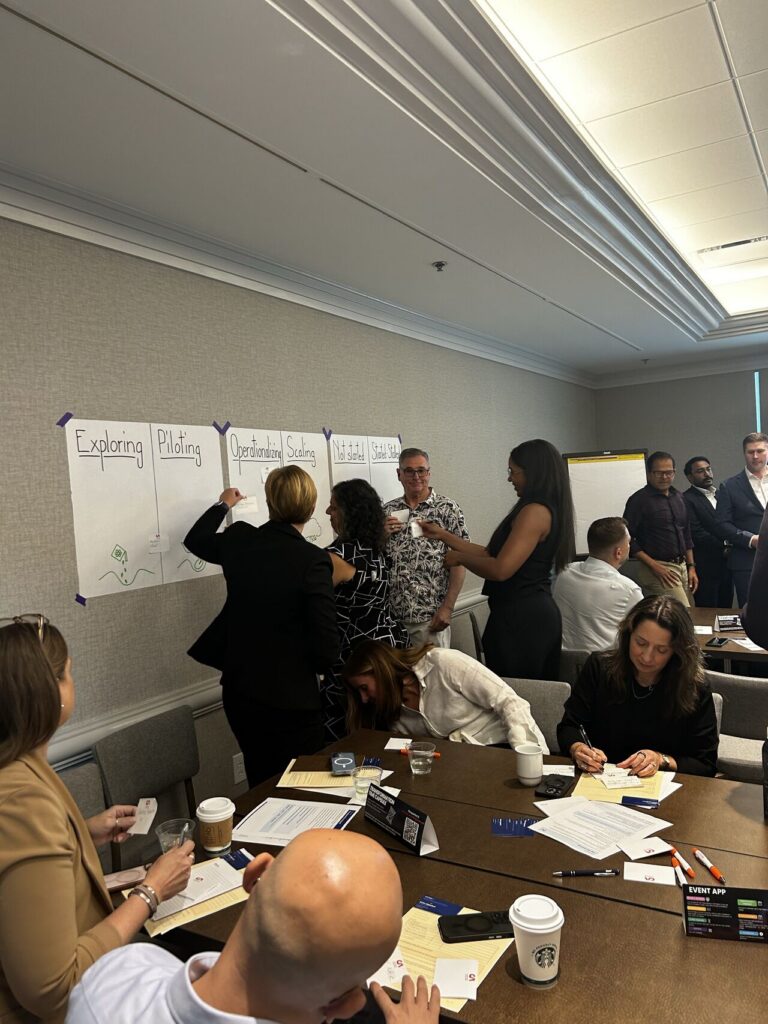
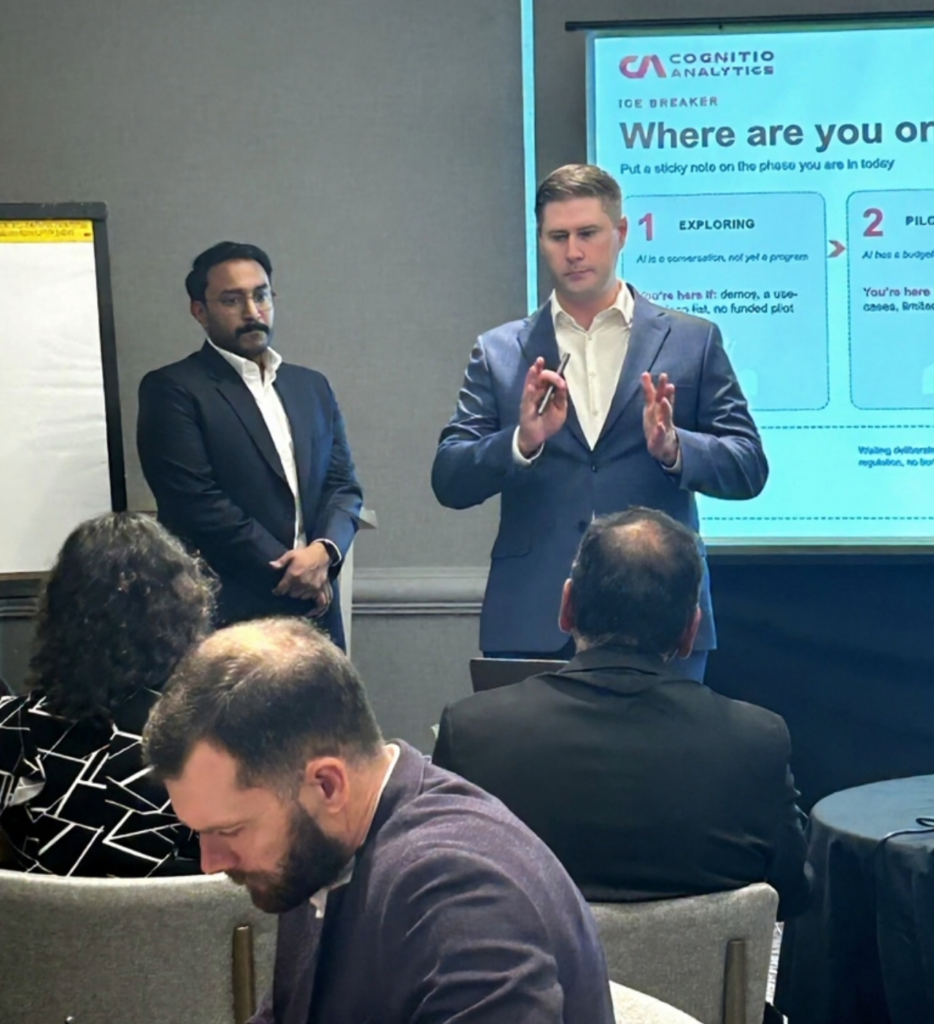
From September 21-23, transformation leaders gathered in Charlotte for the Chief Transformation Officer Exchange. As one of the sponsors, we opened the event with a workshop, “From AI Ambition to Business Value: Addressing Barriers That Derail Transformations.”
A wide range of transformation leaders in the room spoke candidly about their own initiatives, and one sentiment in particular is worth naming before anything else.
Everyone Walked in Thinking They Were Behind. Almost No One Was.
A large number of attendees arrived believing they lagged their peers on AI, only to find that the peer sitting across the table was working through similar struggles. One multi-location consumer business had spent the last several years modernizing its entire data platform, moving off spreadsheets and local databases onto a modern stack, and still described its biggest challenge as simply not knowing how each of its locations actually operates day to day, since performance and practice varied so widely from one site to the next. Others were still early in building out a framework to evaluate which AI use cases were worth pursuing in the first place. Maturity varied, but the underlying fundamentals people were wrestling with, unclear ownership, undocumented process, unproven ROI, looked remarkably similar across industries and company sizes.
The perception of being behind was misleading. The reality is that there are a few specific challenges everyone is working through, regardless of stage.
Two Different Races Are Getting Confused With Each Other
Neel Biswas offered a framing during the workshop that helped explain exactly why that perception is so widespread, and it is worth repeating here.
There are effectively two separate races happening in AI right now. The first is the race between frontier model providers, chasing maximum capability and maximum compute, largely unconcerned with hallucination risk because their incentive is to demonstrate what is possible, not what is dependable. The second is the enterprise race, which is fundamentally risk averse: guardrails, safety, accuracy, and not making costly mistakes at scale.
The problem is that the messaging from the first race bleeds into the second. Enterprises hear about frontier model breakthroughs on a near weekly cadence and, quite naturally, start to feel like they are falling behind. But that comparison is measuring the wrong thing. An enterprise’s pace of progress should be benchmarked against its own performance indicators, its own data. readiness, its own adoption curve, not against the release cadence of a model provider optimizing for an entirely different set of incentives. AI based hallucinations at an enterprise level have higher consequences that LLM chat bots and frontier LLMs don’t face.
Once you separate the two races, the sense of urgency does not disappear, but it becomes a much more useful kind of urgency: focused on your own foundation rather than someone else’s headline.
It Was Not Just an AI Conversation
The two days surfaced a wider set of themes than AI readiness alone, and several of them point in the same direction. Leaders spoke openly about the pressure to keep proving value throughout a transformation rather than only at the business case stage, and the risk of instrumenting metrics that look impressive without ever tying back to a real business outcome. Prioritization came up constantly: with far more opportunities than capacity, the hard decisions are rarely good idea versus bad idea, they are deciding what matters most right now among many legitimate options, and treating some of those bets as experiments to fail fast and cheap rather than get perfectly right the first time. In organizations navigating mergers and acquisitions, the recurring lesson was that integration is a human transformation as much as a technical one, built on transparency about what is known and not known, and genuine curiosity about what made each organization successful in the first place. That played out in practice, too: one recently merged organization was still working through how to bring two entirely different systems, and two different sets of measures and definitions, under one roof, well after the deal itself had closed. And more than one leader pointed out that the moments an organization would never choose, including a serious security incident, can end up becoming the catalyst for change that was needed all along.
Underneath all of it was a simple thread: change fatigue is real, resistance is signal rather than defiance, and the job of a transformation leader is to help people understand the why, not just roll out the what.

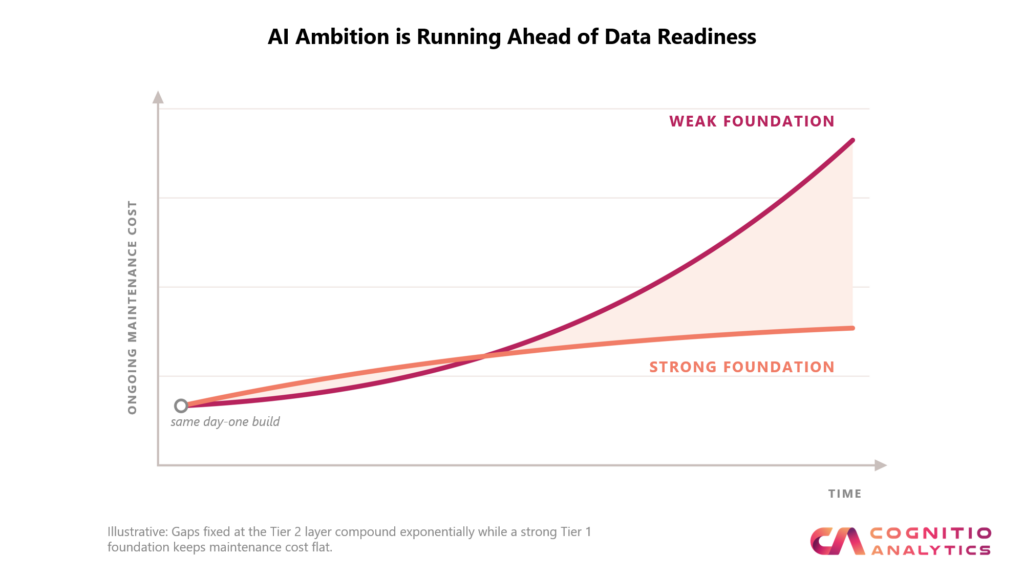
AI Ambition is running ahead of data readiness, which is still hard to crack
The most common theme to surface, specific to AI, was some version of the same complaint: the same piece of information exists in multiple places, defined in different ways, and nobody agrees which one is the source of truth. Critical data lives in documents and spreadsheets rather than structured tables. Systems overlap, hierarchies are poorly mapped, and exceptions outnumber the standard path so often that the “standard process” barely describes what actually happens. It is a widespread enough problem that a recent Salesforce survey of nearly 3,800 leaders across 18 countries found that 19 percent of company data is effectively unusable, despite often containing the most valuable insights.
None of this is a new problem. What is new is the cost of ignoring it. An organization can build an impressive AI pilot on top of fragmented data. It cannot scale one.
Adoption Is a People Problem Wearing a Technology Costume
The second theme had nothing to do with data or models at all. It was about people: change fatigue, unclear guidance on when to trust an AI output, silos between lines of business, and a plain admission that employees simply are not using the tools that were rolled out to them. That last point shows up broadly in the data too. A 2026 BCG survey of nearly 11,750 employees found that 66 percent receive no guidance at all on what to actually do with the AI licenses their employer has already paid for.
This matched almost exactly what we built the workshop around. Weak adoption is not usually a training gap. It is a trust gap, and it shows up as quietly as an unused dashboard rather than as loud resistance.
Nobody Owns the Outcome
A theme that came up again and again, especially from regulated industries, was governance and ownership. The concern, in essence, was the same across conversations: no one owns the outcome, or the value. Business value stays unclear because the ROI was never made apparent in the first place, and without clear governance, decisions default to whoever is willing to make one, not necessarily whoever should. The scale of the gap is stark: a recent Harvard Business Review study of more than 1,000 C-suite executives, conducted with the Return on AI Institute, found that only 2 percent of AI workflows have a clearly assigned, accountable owner.
One version of this showed up often enough to be a pattern of its own: a parent organization sees early AI success and mandates that every regional or business unit find its own AI use case. The mandate arrives, smaller initiatives get launched, and months later nobody can point to a return, because ownership of the value was never assigned in the first place, only the instruction to go build something.
This is the barrier that connects data and people back to the CFO conversation we wrote about ahead of the event. If nobody owns the value, nobody can prove the return.
CASE STUDY
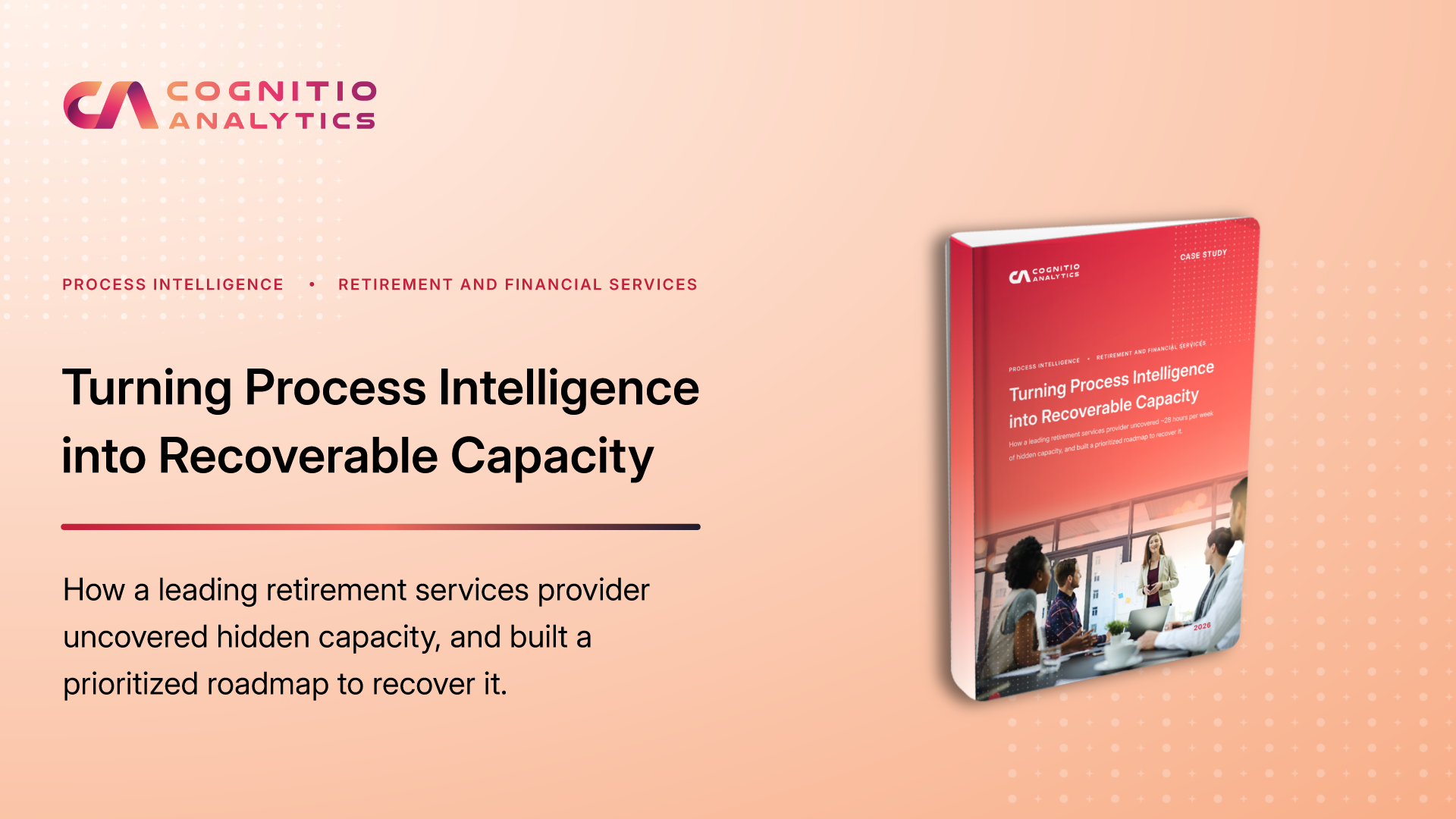
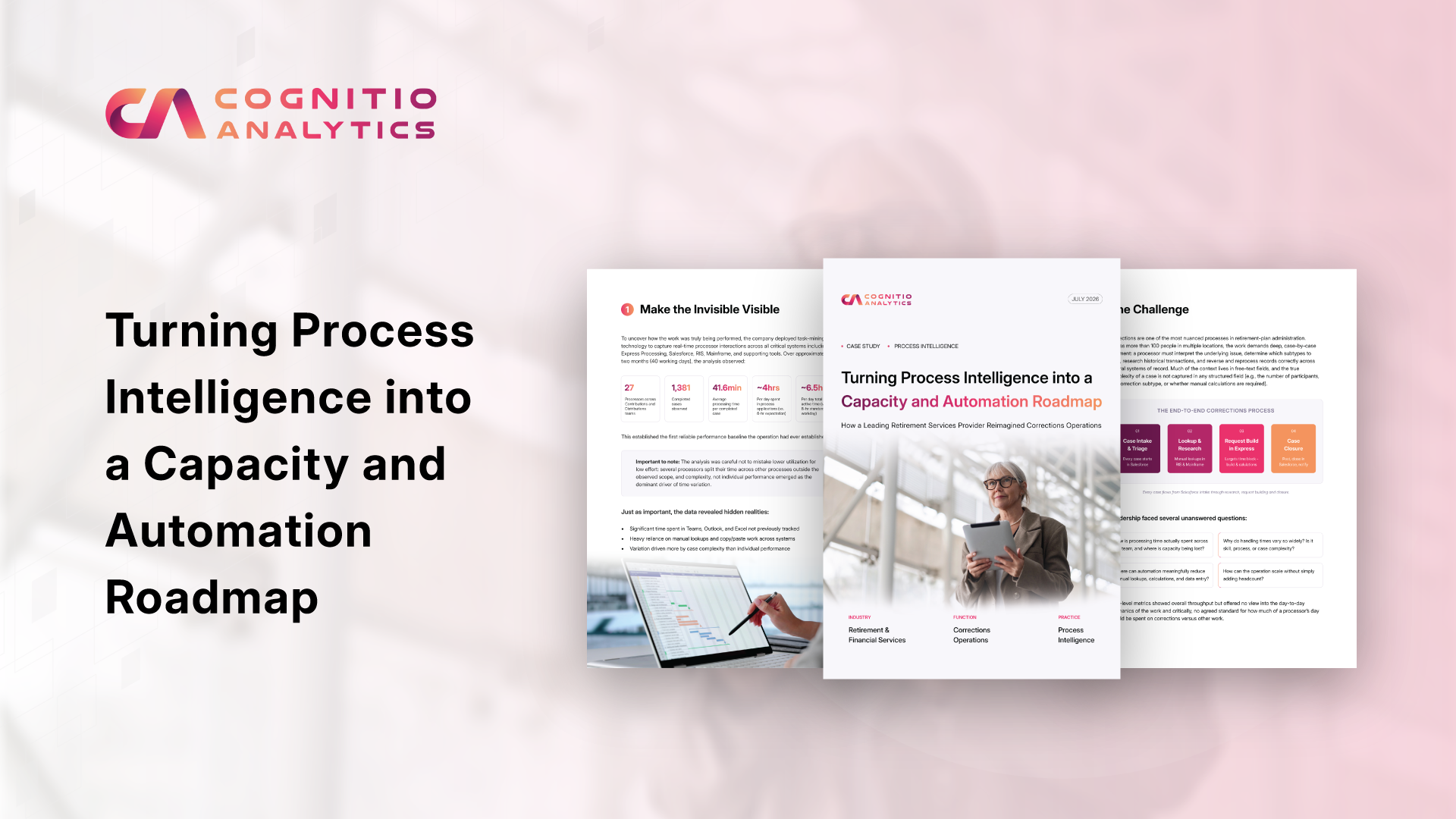
Turning Process Intelligence into Recoverable Capacity
A leading US retirement services firm couldn’t see where its Defined Benefit Case Support team’s time was going. Cognitio analyzed task data, validated it with the team, and identified a three-area roadmap unlocking ~28 hours of weekly capacity.
You Cannot Scale What You Have Not Documented
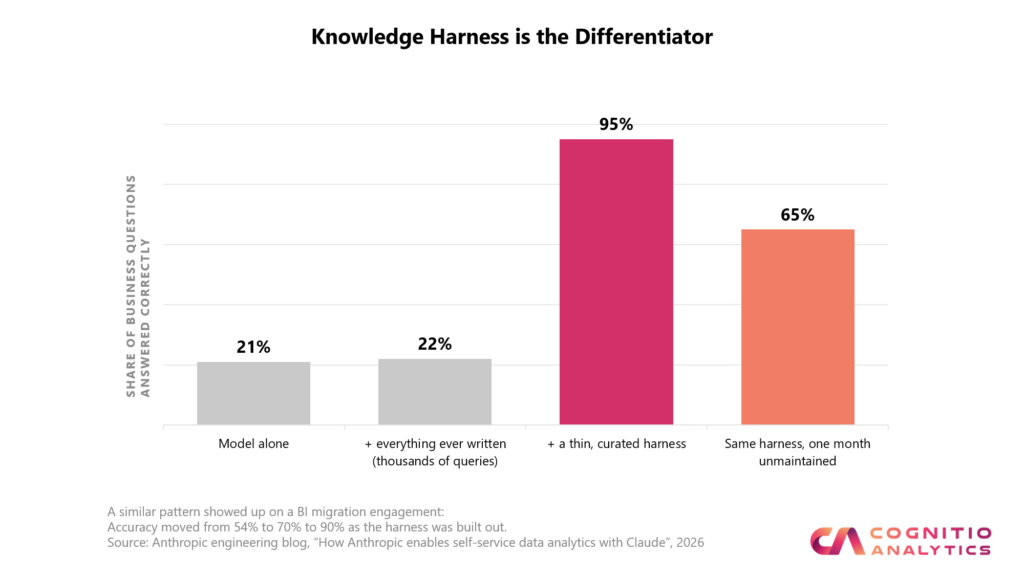
The last theme tied everything together: process knowledge itself is undocumented, fragmented, and inconsistently followed. The dependability of AI outputs is not yet trusted, because the process feeding those outputs was never fully understood to begin with. A 2026 study of more than 540 data leaders found that 93 percent regularly encounter conflicting definitions of the same metric across systems, which is exactly the kind of gap that turns an AI system’s confidence into a hallucination.
Even organizations with a long track record of process discipline are not immune. One financial institution has run a continuous improvement program for well over a decade and has an unusually well documented process repository to show for it, yet most of that documentation was built from employee surveys rather than direct observation, because the organization had no reliable way to capture what people were actually doing as they did it. More than one leader in the room mentioned wanting to run a proper time study or baselining exercise before automating anything further, and just as many admitted they had not gotten around to it yet.
This is the barrier our workshop title points at. Organizations are not failing to scale AI because the technology does not work. They often stall because the operational complexity underneath it was never baselined and mapped clearly enough to automate with confidence.
Fear Is Not a Guardrail
One more pattern deserves its own mention, because it looks like governance but behaves very differently. In more than one conversation, a team wanting to connect its own data sources to an AI system ran into pushback from its own governance or IT function, not because a specific risk had been identified, but because some of the underlying data was unstructured and might contain something sensitive. Rather than getting reviewed and cleared, the initiative simply stopped.
That is a meaningfully different problem from the ones above, and it is worth separating from them. A real guardrail is a specific, engineered rule about what a system must never do, paired with a way to check whether it held. An open-ended fear about what might be hiding in the data is not a guardrail at all, it is just a freeze. The first lets an organization move forward with confidence. The second only postpones the decision.
The Framework We Brought Into the Room
Naming four barriers is one thing. Walking a room through a concrete way to close them is another, and that second half of the workshop is what generated the most engaged conversation of the day.
We shared the AI Operating Playbook we use with clients, which maps directly onto the same four barriers above. It starts with a Tier 1 foundation, the part of the work an organization would need even without AI: reliable data pipelines, a shared semantic layer where every metric means one thing company-wide, a clear map of how the business actually fits together, and governance that makes accountability explicit rather than assumed. On top of that sits a Tier 2 knowledge harness built specifically for AI: orchestration that decides what a given question actually needs, a blueprint for how the work should be done correctly, and guardrails for what must never happen, all wrapped in ongoing observability and evaluation so every miss becomes a lesson rather than a repeat.
Skipping Tier 1 does not remove the cost, it just moves it later and compounds it. A weak foundation and a strong one can start from the same day-one build cost, but every gap patched at the Tier 2 layer afterward gets exponentially more expensive to fix than it would have been at the foundation, and the growing complexity makes hallucinations harder to identify and harder to fix the longer it goes unaddressed. A strong foundation does not eliminate maintenance cost, it just keeps it flat instead of compounding.
We also walked through the four planning stages that sit in front of all of it: picking and validating whether AI is genuinely the right answer to a given problem, planning the setup including the build versus buy decision so many attendees were actively wrestling with, defining how success will actually be measured before anything runs, and only then attaching an expected ROI to a named owner who signs off on it. That last stage is deliberately the point where a mandate to “go find an AI use case” turns into an actual accountable investment.
That framework is also why we do not think the four barriers above are cause for alarm. They are simply the map of where the real work sits, and the room left with a way to walk through it in order rather than all at once.
What This Confirms for Us
The barriers raised in Charlotte aligned with our hypothesis: the operational foundation required to scale AI carries hidden caveats that rarely surface until an organization is already deep into the work. Data readiness, process clarity, and clear ownership are not prerequisites to check off before the real AI work starts, but they determine the accuracy and total cost of your AI solution. They are also where Cognitio Analytics spends most of its time with clients: mapping the data that actually feeds a decision, documenting the process knowledge that lives in people’s heads rather than in a system, and building the governance structures that make ownership explicit rather than assumed.
If any of the barriers above sound familiar in your own organization, we would welcome the chance to compare notes and talk through how we have helped other transformation leaders move past them.
Get in touch with Cognitio Analytics to continue the conversation.
Explore the Latest
Discover trends and strategies shaping smarter, faster business processes.