10 Things Chief Transformation Officers Are Looking Out For
- Published Date:
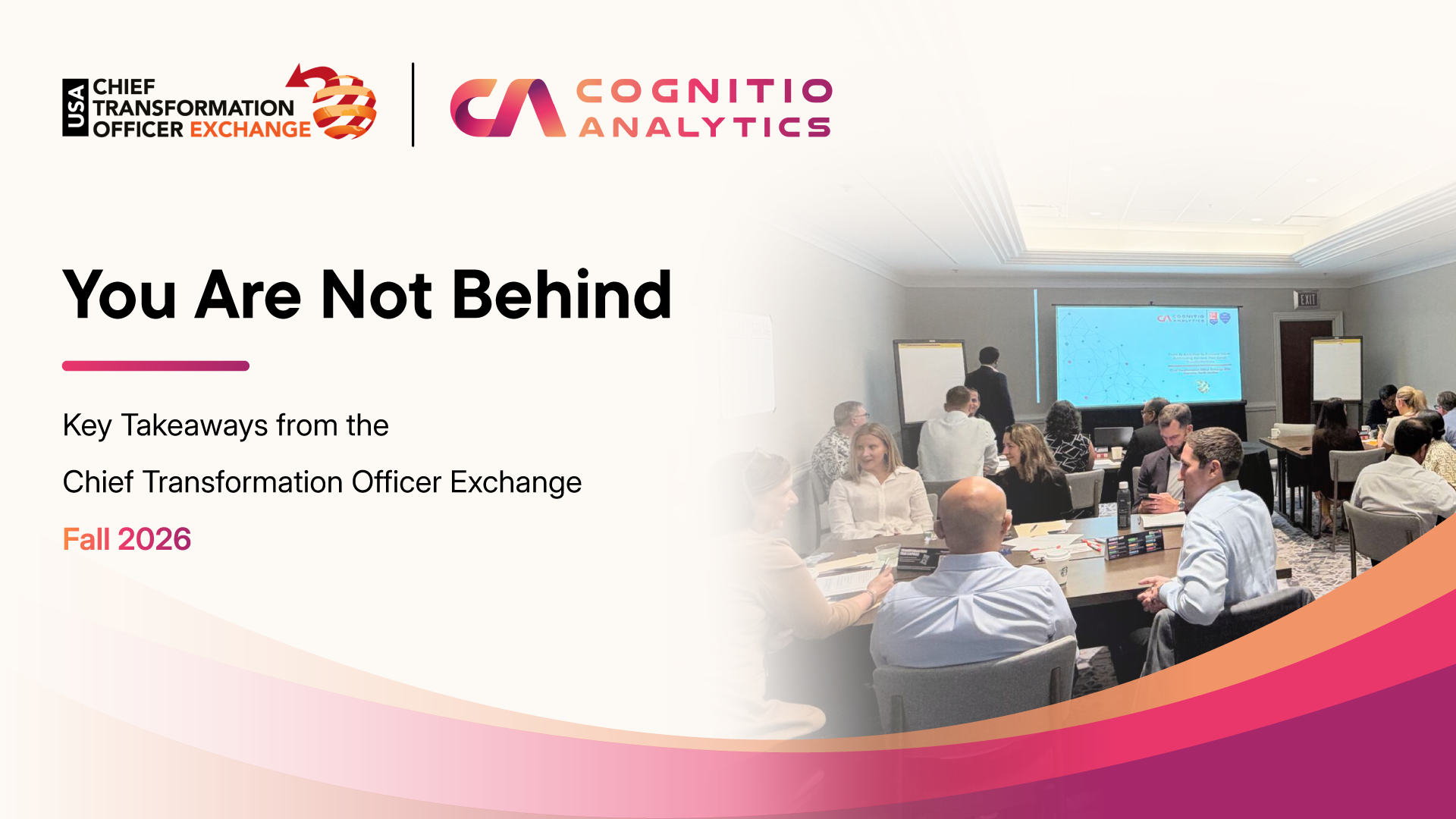
Cognitio Analytics is heading to Charlotte this September as a sponsor of the Chief Transformation Officer Exchange, where we’ll be leading a workshop on the barriers that derail AI-centered transformation and hosting a booth for anyone who wants to compare notes.
Ahead of the event, we’ve been in conversation with transformation leaders across industries about their top priorities. A clear picture is forming, and it lines up closely with the topic of the workshop. Here are the 10 most commonly stated challenges, and where we think the industry is headed.
1. The ROI question isn’t going away; it’s getting harder to answer
Nearly every transformation leader we talk to is being asked the same thing by their board: where’s the return? The twist in 2026 is that the old ROI playbook, built for discrete software rollouts, doesn’t map cleanly onto AI initiatives where value typically shows up as incremental capacity created rather than absolute headcount removed. We spend a lot of our own client work developing business cases a CFO will sign off on, and the organizations getting this right are the ones treating financial validation as a discipline, not an afterthought.
“Every year at the Exchange, the conversation gets more honest about where transformation actually breaks down. We’re looking forward to bringing that same honesty to Charlotte, and to comparing notes with leaders who are working through these same challenges in real time.”

Roger Potter, Co-Founder & Chief Analytics Officer
2. Data readiness is the quiet blocker behind AI ambition
Most leaders we’ve spoken with, name the same root cause when their AI pilots stall: fragmented data spread across too many systems, with no single reliable view of the business. Governance, quality, and observability are no longer back-office concerns, they’re the precondition for scaling anything AI touches. This is the reason we start engagements with process and data discovery before we talk about tooling. You can’t automate what you can’t see and understand clearly.
This is one of the barriers we’re unpacking directly in our workshop, “From AI Ambition to Business Value: Addressing Barriers That Derail Transformations.” Poor data readiness and quality is one of the most common obstacles we see limiting AI-driven decision making, and we’ll be drawing on real-world experience across industries to talk through what moves the needle.
“Data readiness and change adoption sound like two different problems, but in practice they’re deeply connected. If people don’t trust the data, they won’t trust the decisions built on it. We’re looking forward to a candid discussion on both.”

Neel Biswas, AVP, Intelligent Operations
3. Legacy systems and fragmented platforms are still the elephant in the room
Behind a lot of the AI conversation is a much less glamorous reality: many organizations are still running on a patchwork of legacy systems and disconnected platforms. Consolidation and integration work is ongoing, but it has been deprioritized in favor of AI-focused initiatives. This is another barrier that we will examine in our workshop; “insufficient understanding of system, operational and process complexity,”. We’d argue it’s the actual foundation the rest of the AI roadmap sits on. Skipping it doesn’t make it go away.
“Most organizations don’t fail because the AI technology doesn’t work. They fail because the complexity underneath it was never fully understood. That’s why the knowledge harness matters and each layer has to be addressed accordingly.”

Pascal Foelix, VP, Intelligent Automation Solutions
4. Change adoption remains the single biggest investment priority for transformation leaders right now
Across all initiatives that transformation leaders are prioritizing, change leadership and adoption comes out on top, ahead of any specific technology. Initiative fatigue, resistance from the frontline, and the gap between a rollout and genuine behaviour change are recurring themes. It’s a pattern we see frequently in our own work: the best technology in the world doesn’t deliver value if people don’t use it apropriately. It’s often the differentiator between transformations that stick and ones that quietly revert once the spotlight moves elsewhere.
5. Operating models are being redesigned around AI, not just digitized
AI is not about layering a chatbot onto an existing process. Leaders are rethinking org design itself, from where decisions get made to what a “lean” organization looks like when AI takes on more of the operational load. From what we’ve seen, operating model redesign has to happen in parallel with data and process work, not after it. Sequencing this wrong is one of the most common reasons transformation stalls.
6. Workforce skills and human-AI collaboration are becoming a strategic priority
Upskilling kept surfacing in our pre-event conversations, but with a twist: it’s less about teaching people to use a new tool and more about redesigning roles entirely around what AI can take on. Leaders want frameworks for deciding what stays human, what becomes AI-assisted, and what gets automated outright. This is where transformation and talent strategy converge, and we expect it to be a central thread across the dialogue at the conference.
7. Securing executive and CFO buy-in is still harder than expected
Even with clear business cases, several leaders described the same friction: getting the C-suite, and especially finance, genuinely aligned on funding transformation and AI investment beyond the pilot stage. The organizations that win here tend to treat the CFO as a partner early, not a gate to clear at the end. Bringing financial rigor into the conversation from day one changes the dynamic and secures early buy-in.
8. Growth and M&A are reshaping the transformation agenda
For organizations scaling quickly or integrating acquisitions, transformation isn’t optional, it’s existential. Bringing together different systems, cultures, and ways of working while still hitting synergy targets is proving to be one of the harder problems in the room. The pace of change matters as much as the plan itself here. Rushed integrations tend to create the very inefficiencies transformation is supposed to remove.
9. Leadership resilience is finally being treated as a transformation capability
Perhaps the most human theme we’re hearing: transformation leaders are tired. Between AI hype, constant reprioritization, and organizational change fatigue, there’s a growing recognition that the leader’s own resilience deserves the same intentional investment as any technology roadmap. We’re glad to see this getting airtime. Sustainable transformation depends on sustainable leaders.
10. Agentic AI is exciting leadership and worrying risk teams in equal measure
The shift from copilots to autonomous agents is accelerating faster than most governance frameworks can keep up with. Leaders are asking hard questions about who owns accountability when an AI agent, not a person, makes a decision that goes wrong. In our experience, governance shouldn’t be a brake on innovation, it should lay the foundation that lets you move faster with confidence. Expect this tension to show up in almost every agentic AI conversation.
We’ll be exploring several of these themes, especially the gap between AI ambition and realized business value, in our workshop at the Exchange:
From AI Ambition to Business Value: Addressing Barriers That Derail Transformations
Despite significant investment in AI-centered transformation initiatives, executives often face inconsistent results, stalled adoption, and benefits that are difficult to measure or scale. Cognitio Analytics will draw on real-world experience across multiple industries to examine the most common obstacles preventing organizations from realizing measurable returns, including data readiness, process complexity, and change adoption, followed by a facilitated discussion to exchange lessons learned with peers.
Speakers: Pascal Foelix and Neel Biswas
If you’re heading to Charlotte, we’d love to see you there. Learn more and connect with us at the Exchange.
Explore the Latest
Discover trends and strategies shaping smarter, faster business processes.