AI can read your data. It can’t yet see how your business runs.
Most AI initiatives don’t fail on the technology. They stall because the AI can’t see how the business actually runs: where work slows down, where exceptions pile up, and what a good outcome looks like.
2%
of AI workflows have clearly accountable owners
HBR / Return on AI Institute, 2026
93%
of data leaders run into conflicting metric definitions across systems
Modern Data 101, 2026
66%
of workers get no guidance on how to use the AI tools they’ve been given
BCG AI at Work, 2026
None of these gaps closes with more technology. They close when AI is built into the way the organization works.
What you’ll learn
A practical playbook for scaling AI that pays off
01
Why AI initiatives stall
Four barriers that hold AI back: data it can’t reach, process knowledge it doesn’t have, people who don’t adopt it, and decisions no one owns.
02
How process intelligence gives AI business context
Reading data is one thing. Understanding how work actually flows is another.
03
A live AI demo
See an AI assistant answer real questions about where a process slows down, and why.
04
How to prioritize and measure impact
A four-step approach to choosing use cases, setting a baseline, and assigning ownership of ROI.
The session closes with key takeaways, next steps, and a live Q&A with the speakers.
WEBINAR HIGHLIGHT
AI that understands your processes
Watch an AI assistant connected to QPR ProcessAnalyzer through MCP (Model Context Protocol) answer business questions using live process data.
AI stalls when it can’t see how work actually flows.
Disconnected systems and unclear ownership create blind spots.
Without a baseline, ROI is hard to prove.
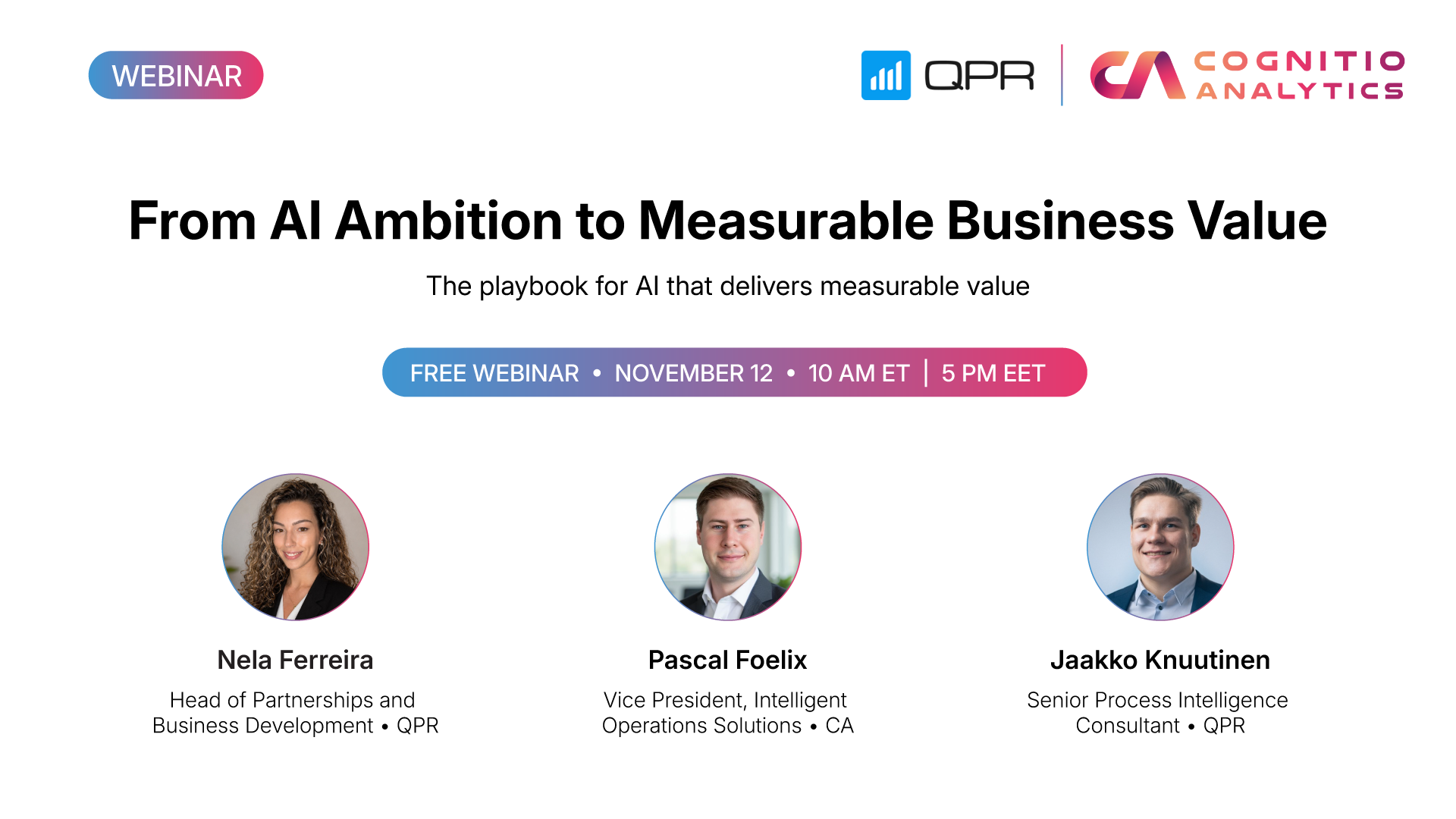
A conversation with Pascal can help you pinpoint where process intelligence fits and where to start.
With 15 years leading digitization, automation, and process reengineering transformations, Pascal helps teams uncover inefficiencies and drive rapid productivity gains.